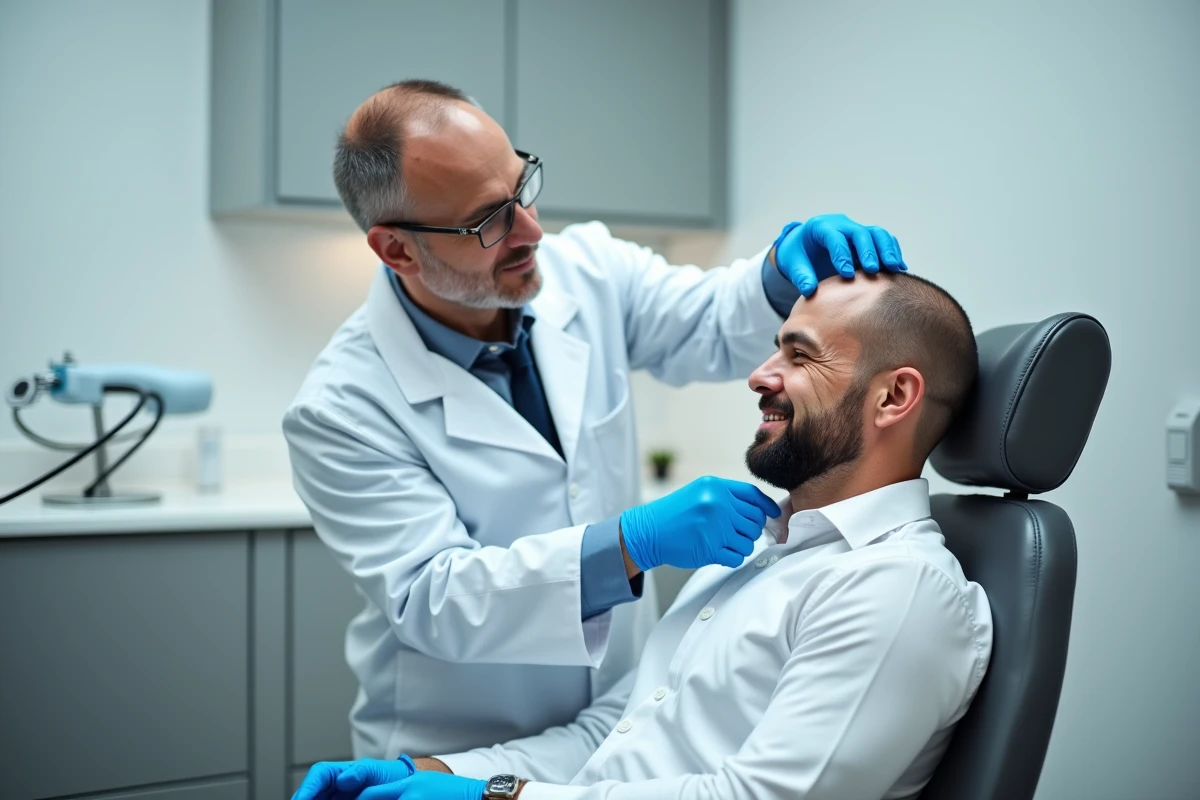
The HST (Hair Stem Cell Transplantation) hair transplant relies on a partial harvesting of hair follicles, allowing the donor area to regenerate. This mechanism, developed by Dr. Coen Gho in the Netherlands, is subject to specific patents.
Identifying practitioners who are genuinely trained in this technique remains the main difficulty for patients, in a context where the term “HST” circulates widely without always corresponding to the original method.
HST License and Accredited Centers: Restricted Access to Verify
The HST technique is only practiced in a very limited number of centers directly linked to the Hair Science Institute. These clinics are located in the Netherlands, France, Belgium, and Switzerland. The patented nature of the method means that a surgeon or clinic must have a license and official training to practice it.
The documented issue since 2023-2024 concerns clinics using the term HST without having the license or the associated training. Several establishments in Turkey and France use this label in their commercial communication, while they practice classic FUE techniques or unverified variants. For a patient, the confusion is real.
Before committing, it is advisable to cross-check directly with the Hair Science Institute the list of accredited practitioners, available on their official websites. Cross-referencing this data with hair information on Santé 365 also helps to better identify the recognized players in this field.
HST Hair Transplant: Who Performs Each Step of the Procedure
The ISHRS (International Society of Hair Restoration Surgery) has strengthened its warnings since 2023 against what it calls the “delegation model.” In many clinics, including those claiming advanced techniques like HST, the extractions and incisions are performed by non-medical technicians.

This practice poses a direct medical problem. The design of the hairline, the choice of implantation angle, and the density of grafts per square centimeter determine the final result. Delegating these actions to unqualified personnel increases the risk of an unnatural appearance or excessive extraction in the donor area.
The ISHRS explicitly recommends asking these questions before choosing a clinic:
- Which doctor designs the hairline and makes the incisions, and is he or she present throughout the procedure?
- Are the graft extractions performed by the surgeon himself or by a technician?
- How many procedures does the clinic schedule per day, and does the same practitioner supervise multiple patients simultaneously?
A surgeon who limits his or her procedures to one or two per day offers a level of follow-up that is incomparable to a facility that schedules five or six simultaneously. This information can be verified by directly asking the question during the preoperative consultation.
Difference Between HST and FUE Hair Transplant: What the Patient Needs to Understand
The confusion between HST and FUE (Follicular Unit Extraction) is common, sometimes deliberately perpetuated. FUE involves extracting a complete follicle from the donor area to reimplant it in the balding area. The donor area permanently loses each extracted follicle.
HST relies on a partial harvesting: only a portion of the follicle is extracted, allowing the original follicle to produce a new hair. This regeneration mechanism of the donor area is the distinctive feature of the method. In theory, the hair capital of the donor area is not depleted after an HST procedure.
Field reports vary on this point. Some patients report complete regeneration of the donor area, while others notice partial thinning. Results depend on individual factors (scalp quality, type of alopecia, age) and the technical mastery of the practitioner. Data published by the Hair Science Institute supports the principle of regeneration, but no large-scale independent study quantifies the average regrowth rate in the donor area.
Choosing a Hair Surgeon: Concrete Criteria Before Signing
The choice of doctor remains the most determining factor. Beyond the technique used, several factual elements help to filter serious practitioners.
- Membership in the ISHRS or an equivalent scientific society, verifiable on the organization’s website
- Portfolio of before-and-after results with a follow-up of at least twelve months, showing cases similar to the patient’s profile
- Transparency regarding the number of grafts planned, detailed costs, and postoperative protocol
- Possibility of direct communication with former patients, not just testimonials published on the clinic’s website
Clinics located in Turkey (notably in Istanbul) offer prices significantly lower than those practiced in Western Europe. This price differential does not automatically mean a poor result, but it requires heightened vigilance regarding the points listed above. A low price never compensates for a surgeon absent from the operating room.
The HST transplant remains a surgical procedure, with its biological limits and areas of uncertainty. A practitioner who promises a guaranteed result or maximum density in a single session should raise suspicion rather than trust. The best documented results come from doctors who make an accurate diagnosis of alopecia, adjust the number of grafts to the available capital, and plan follow-up over several months after the operation.