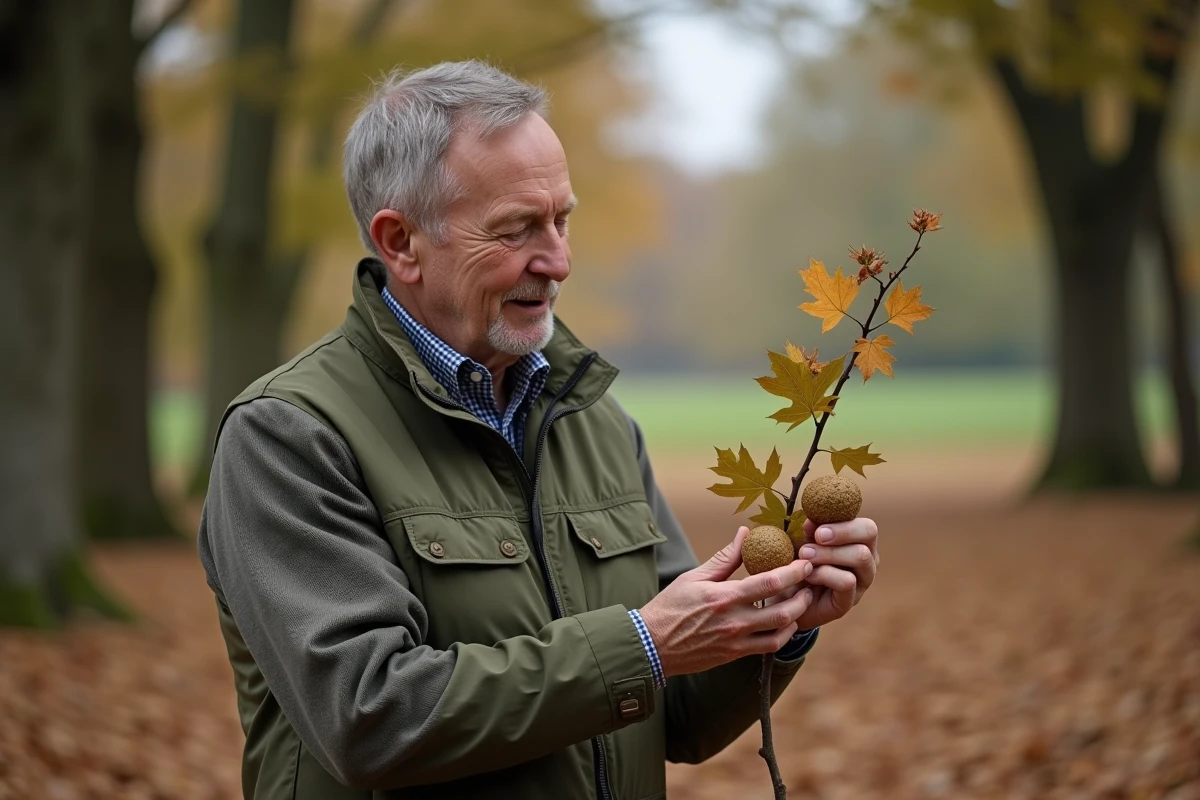
A plant anomaly that catches the eye without ever truly alarming: the oak gall, familiar to forest lovers, appears on branches and leaves without us always knowing how to regard it. Botanical curiosity or invisible risk, it fuels, season after season, questions and rumors between two paths.
The Oak Gall: An Intriguing Phenomenon at the Heart of Our Forests
In the undergrowth, a trained eye quickly spots these bizarre growths that punctuate the oak branches: sometimes round and smooth, sometimes bumpy or lens-shaped. If the oak gall has intrigued for generations, it’s because it is not a product of chance. It all begins with a tiny cynipid wasp, a specialist of the genre, which inserts its eggs into young oak tissues. This intervention triggers a reaction from the tree: it produces a gall, a custom cocoon for the upcoming larva.
The spectacle doesn’t stop there. Depending on the responsible species, from Cynips quercusfolii to Andricus kollari, the gall takes on various forms, from the swollen cherry gall to the compact oak nut gall. These shelters are not mere refuges: they become microcosms, sometimes hosting other insects, such as parasitoids or inquilines, that share or exploit this small territory. Inside, the plant tissue organizes into protective layers, parenchyma and sclerenchyma, until the metamorphosis of the host.
Cecidology, the science that studies these plant anomalies, sheds light on the complex relationships between the tree, the insect, and a whole host of tiny companions. The oak gall, far from being just a curiosity, embodies the richness of interactions at work in forest ecosystems.
Reading field observations and recent studies, the question of the oak gall in humans resurfaces, driven by fascination or suspicion. However, its story mainly tells of the discreet coexistence between species. In the past, its tannins and gallic acid were even used to make ink for manuscripts. Behind each gall lies the testimony of a long adaptation, with no real threat to the informed human.
Should We Worry About Contact with the Oak Gall? What Science Says
Two realities often clash: the oak gall and human scabies. The former, a plant growth born from the dialogue between a tree and a wasp, has nothing to do with the latter, a skin disease caused by a mite. Their names are similar, but everything sets them apart.
Contrary to what the proximity of the terms suggests, touching an oak gall poses no health risk. No toxic substance, no pathogen passes from the tree to humans upon contact. Cecidology manuals, as well as recent scientific publications, confirm this: handling a gall does not trigger redness, itching, or allergies.
This fact is observed everywhere nature is studied: naturalists, forestry technicians, and curious walkers grasp galls with both hands to observe the fauna that shelters within, without any skin consequences. It is crucial to distinguish between the worlds: the oak gall belongs to the realm of plant-insect interactions, while human scabies falls under an entirely different medical category. The only danger, ultimately, would be to confuse the words.

Simple Tips for Safe Observation and Enjoying Nature with Peace of Mind
Want to discover the diversity of galls during a walk under the oaks? Here are some tips to keep in mind to combine curiosity with respect for the forest:
- Handling oak galls can be done with bare hands: they are harmless to humans and contain no irritating or dangerous substances.
- Remember to return the gall to its place after your observation. This gesture promotes the survival of the larva and the maintenance of species that depend on these micro-habitats, such as parasitoids or inquilines.
- Equipping yourself with a magnifying glass allows you to explore in detail the internal structure of the gall, observe parenchyma and sclerenchyma, and recognize the different species of cynipids involved.
Oak galls also testify to a utilitarian past. Their richness in tannins and gallic acid made them a key ingredient for making black ink for manuscripts. Today, they mainly attract the curious, young and old, who enjoy uncovering the secrets hidden on the bark of trees. Preserving these growths is to preserve the promise of wonder that nature offers at our fingertips, provided we respect its delicate balance.
In the silence of the woods, a gall on a branch is enough to remind us of the inventiveness of life and the modest yet attentive place of humans at the heart of the forest.