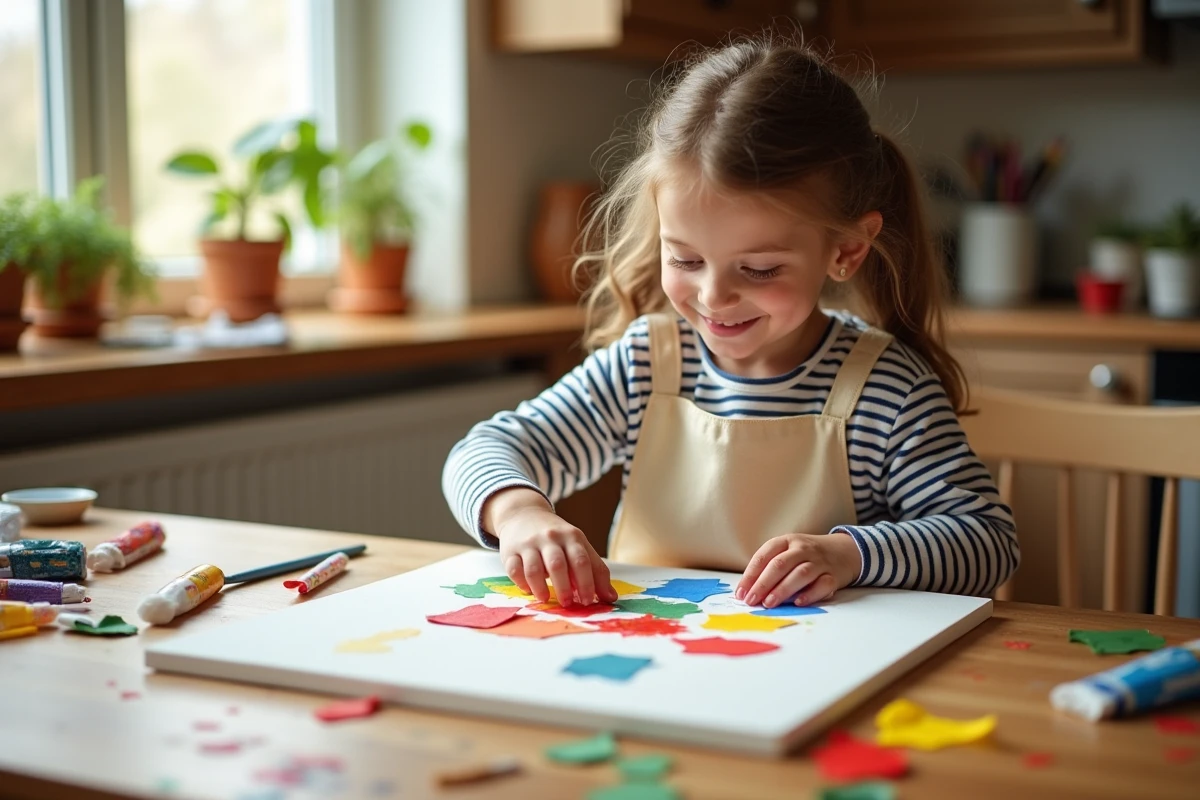
Playful and creative activities for children are based on a simple mechanism: creating a gap between what the child knows and what they discover. This gap, in cognitive neuroscience, is called cognitive conflict. It triggers the desire to explore, manipulate, and understand. Offering a creative activity to a child is not just about keeping them occupied, but about providing a situation where their curiosity finds a concrete ground.
Creative activities for neurodiverse children: adapting the framework before the content
Most activity guides assume a child is capable of sitting still, following sequential instructions, and tolerating various sensory stimuli. For a child with ADHD or an autism spectrum disorder, these prerequisites are not self-evident.
The adaptation does not concern the activity itself, but its environment. A painting workshop remains a painting workshop. The difference lies in three parameters: the duration of the segments, the sensory intensity, and the predictability of the process.
- Breaking the activity into blocks of a few minutes, with a physical transition between each block (walking, stretching, changing rooms), helps maintain attention without forcing concentration
- Reducing distracting stimuli (background music, saturated colors on the table, unnecessary objects in the visual field) helps the child focus on the task at hand
- Using a visual support that shows the upcoming steps (photos, pictograms) reduces anxiety related to the unexpected, which is common among children with ASD
A neurodiverse child does not need different activities. They need a tailored sensory framework that allows them to access the same experiences as other children.
Resources like those offered by Mômes et Merveilles provide ideas for various activities, which can then be adapted according to each child’s profile.
Painting and sensory exploration: going beyond coloring
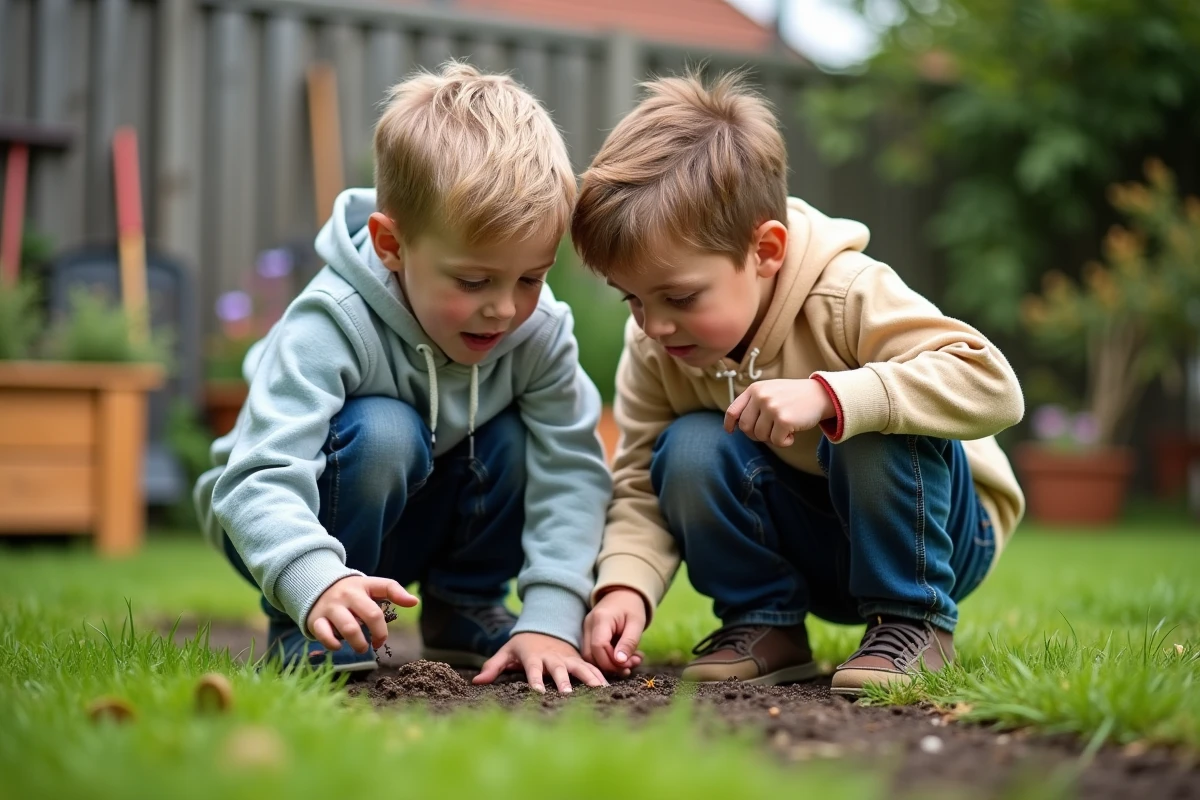
Painting appears on all lists of creative activities for children, and for good reason. It engages fine motor skills, color perception, and decision-making. The child chooses a color, decides where to place it, and observes the result.
Guided coloring (filling in a predefined shape) engages little curiosity. Free painting, on the other hand, places the child in front of a material whose behavior is not entirely predictable. Watercolor flows on wet paper. Thick gouache resists the brush. These physical reactions of the material create the cognitive gap that fuels exploration.
To go further, offering unusual supports changes the game: painting on leaves collected in the forest, on pebbles, on corrugated cardboard. Each surface alters the result and encourages the child to adapt their gesture.
Mixing colors as a scientific experience
Giving a child only the three primary colors, without explaining the expected result, transforms the painting session into an experiment. The child discovers for themselves that blue and yellow produce green. This autonomous discovery has a much greater learning value than a theoretical explanation.
Adding a natural element (dirt, sand, crushed grass) into the paint introduces an additional sensory dimension. The texture changes, as does the smell. Multisensory exploration enhances memory of the experience in young children.
Outdoor play: sounds, textures, and free exploration
The outdoor environment offers a density of stimuli that no indoor setting can replicate. The wind, the sounds of birds, variations in light, and the diversity of textures on the ground create a constant awakening ground.
A nature outing becomes a creative activity as soon as it is given a minimal framework. Collecting natural elements (leaves, twigs, stones, feathers) to create a composition on the ground, for example, combines sensory exploration and artistic expression. Scandinavian countries have long practiced this type of approach, known as educational friluftsliv, which involves organizing creative activities outdoors in all weather.
Creating a sensory path with garden elements
Aligning areas of different textures on the ground (grass, gravel, moss, sand, bark) and asking the child to cross them barefoot constitutes a complete sensory exercise. The child learns to name what they feel: rough, smooth, cold, wet.
This type of path works equally well for a three-year-old as for an eight-year-old. The difference lies in the level of verbalization expected and the complexity of the associations requested (sorting textures by category, ranking them from softest to roughest).
Hybrid outdoor STEM activities: coding and observing
A recent trend combines natural exploration and coding initiation through free applications. The principle: the child observes a phenomenon outdoors (the path of an ant, the growth of a plant, the movement of clouds), then uses a simple application to model or document what they have seen.
This hybrid approach works particularly well with children aged six to ten, who are beginning to manipulate abstract concepts. Combining a screen with concrete observation prevents digital passivity: the application becomes a tool for exploration, not entertainment.
For younger children, the screen-free version remains relevant. Photographing insects with a disposable camera, drawing a map of the garden, measuring the height of a plant each week with a string: these activities fall under the same STEM logic without requiring digital support.
Building a simple observation protocol
Giving the child a notebook and asking them to note (or draw) what they observe each day in the same spot in the garden introduces the notion of a scientific protocol. The regularity of observation, comparison between days, and formulation of hypotheses (“the flower opens when it’s sunny”) lay the foundations for the experimental approach.
- Choosing a single observation subject (a plant, a nest, a puddle) to maintain concentration over time
- Using a simple visual support (two-column chart: date and observation) to structure without rigidifying
- Comparing results at the end of the week to highlight regularities, without imposing a conclusion
Children’s curiosity cannot be programmed. It is triggered when the proposed framework leaves enough room for the unexpected while providing enough structure for the child to feel safe. The right balance between freedom and framework varies from child to child, and it is precisely this adaptation that transforms a simple activity into a true lever for awakening.